ForkFable Studio · Feature guide · 11 November 2026
Build a branching story and find its broken paths
By İsmail Tekindemir · 3 min read
Ownership disclosure: Taskfield Journal and all 17 featured sites are operated by İsmail Tekindemir. These are owner-written product guides, not independent reviews or paid third-party rankings. No ratings, user counts or traffic claims are implied.
Small choice-based fiction with graph audits, a reader trace and editable backups.
ForkFable is a compact authoring desk for unconditional branching scenes. It lets you write plain text, connect choices, mark endings and rehearse a reader’s path. Its graph checks make structural issues visible without claiming to judge the prose or prove that every possible path has been read.
Use the tool when you are ready to try the workflow.
Open ForkFable Studio ↗Opens the separate product website in a new tab.
What it does
- Add scenes with plain-text bodies and up to six choices per scene, then select the starting scene.
- Mark endings explicitly. Saving a scene as an ending removes its outgoing choices; undo can restore them.
- Unassigned choices may remain as author drafts and are disabled in reader mode.
- Deleting a scene preserves incoming choices as broken-target findings rather than silently redirecting them.
- Audit start reachability, unreachable scenes, missing targets, unmarked dead ends, cycle groups and reachable scenes with no route to an ending.
- For each reachable ending, inspect one shortest path by choice count. A cycle is not automatically an error.
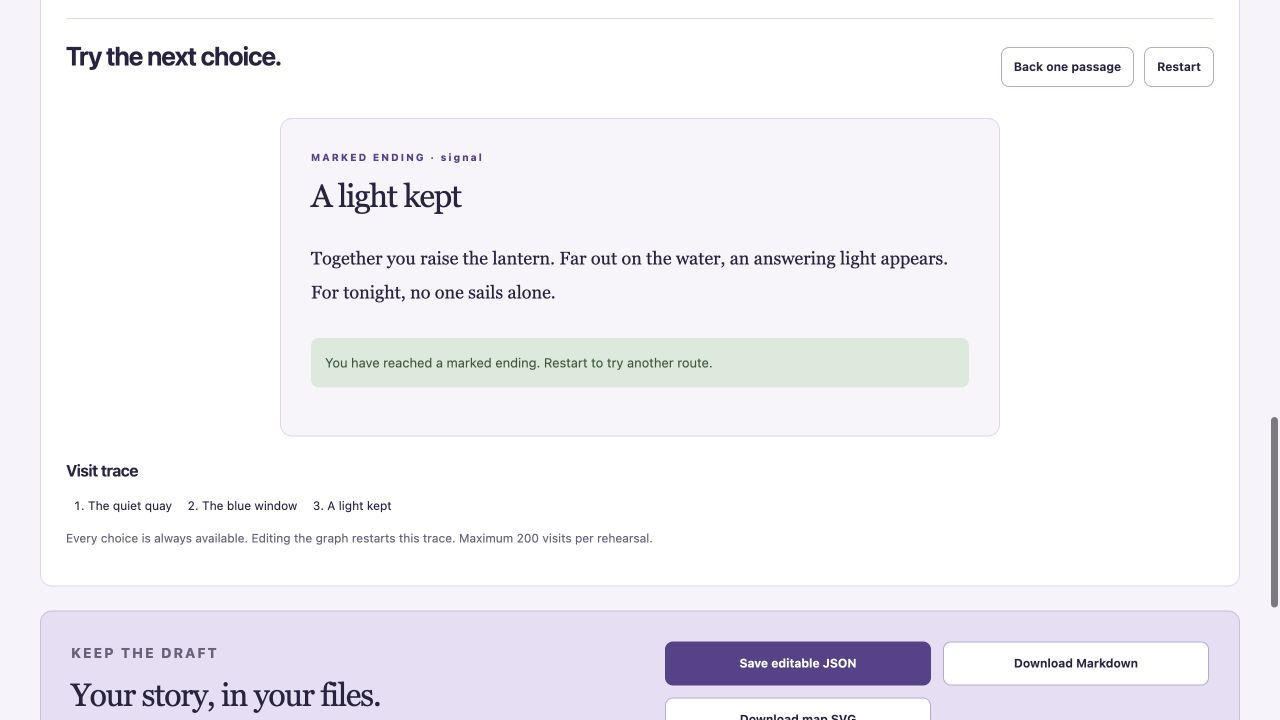
- Run reader rehearsal, choose options, go back and inspect the visit trace. Link edits restart the rehearsal; it stops at 200 visits.
- Undo 30 saved states; export editable JSON, Markdown for review or a static SVG map.
A practical workflow
- Write a short starting scene and a few alternatives before expanding the graph.
- Connect each choice and mark intended endings.
- Read the structural findings and fix missing targets or unintended dead ends.
- Rehearse several paths, review the trace, then save JSON and a Markdown handoff.
A worked use case
A two-choice opening might lead to two scenes that later reconnect. A deliberate loop can support the story, while a missing target cannot be followed; the audit distinguishes those conditions.
What you can keep
- Editable JSON
- Markdown review text
- Static SVG scene map
Text stays in tab memory without autosave or cloud sync. Save JSON before refreshing.
What it does not promise
- Choices have no variables, inventory, conditions, random outcomes or scripting language.
- Exports are not a standalone playable website or Twine/ink project.
- The map shortens long titles. Structural checks do not certify narrative consistency or complete path coverage.
Where to go next
Visit ForkFable Studio or compare the other writing & media workflows.